

The Berbice slave uprising was a slave revolt in Guyana that began on 23 February 1763 and lasted to December, with leaders including Coffy. It is seen as a major event in Guyana’s anti-colonial struggles, and when Guyana became a republic in 1970 the state declared 23 February as a day to commemorate the start of the Berbice slave revolt.
| Berbice Rebellion | |||||||
|---|---|---|---|---|---|---|---|
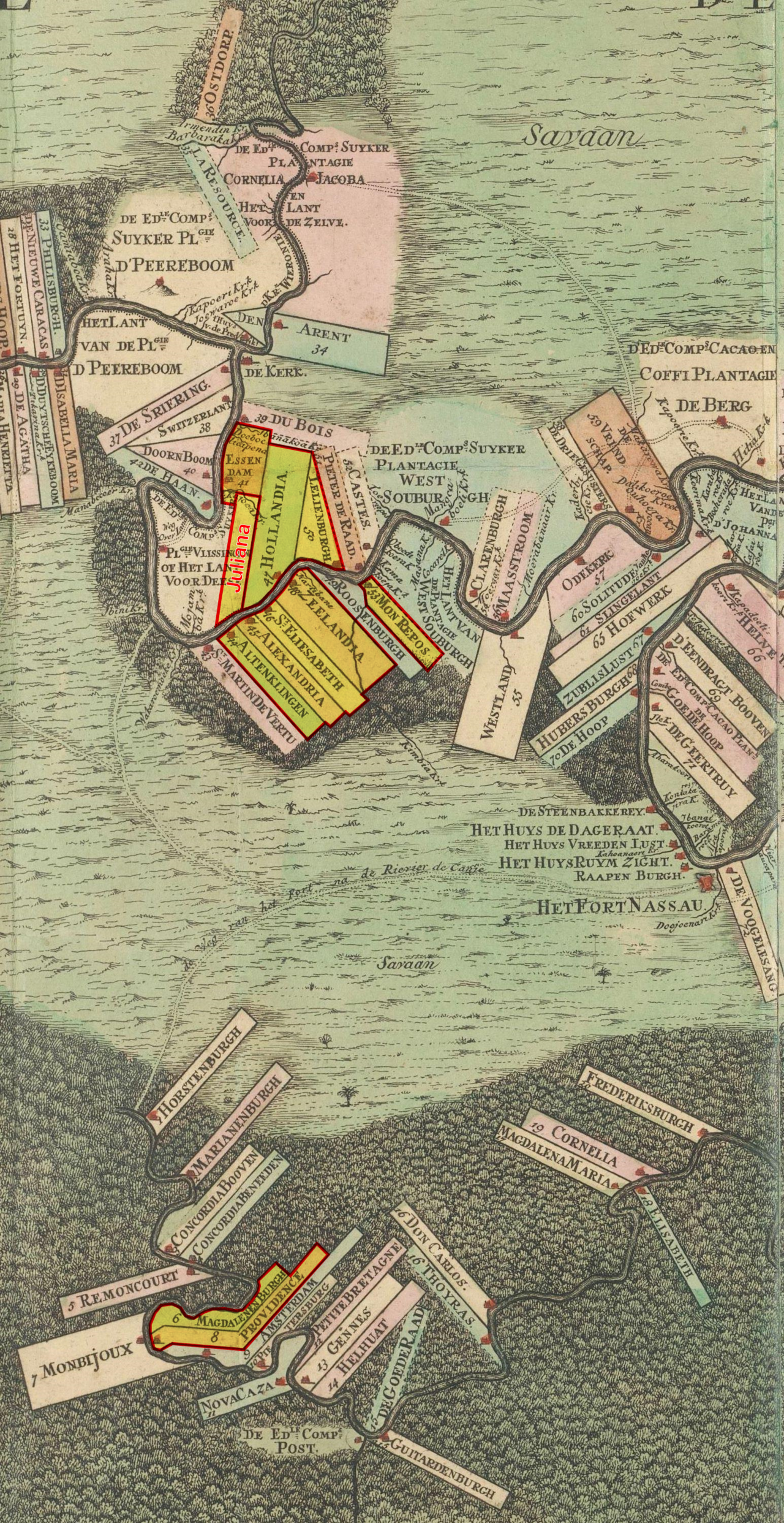
 The revolting plantations (highlighted) | |||||||
| |||||||
| Belligerents | |||||||
 Dutch Republic Dutch Republic  Barbados BarbadosArawak Kalina | Rebels | ||||||
| Commanders and leaders | |||||||
|
Wolfert van Hoogenheim Louis-Henri Fourgeoud Duke Louis Ernest of Brunswick-Lüneburg |
Governor Cuffy Captain Atta Captain Accara Captain Accabre[2][3] | ||||||
| Casualties and losses | |||||||
| ±50 | ±1800 | ||||||
The Berbice Rebellion was a slave rebellion in Berbice, Dutch Guiana[2][4] (present-day Guyana), that began on 27 February 1763[3] and lasted to April 1764,[5] with among them the famous rebel leader Cuffy.[a] This was the first major slave revolt in South America,[5] and it is seen as a major event in Guyana's anti-colonial struggles. When Guyana became an independent republic in 1970 the state declared the anniversary of Cuffy's slave rebellion on 23 February as the Republic Day, a day to commemorate the start of the Berbice slave revolt.[3] Cuffy is a national hero commemorated in a large monument in the capital, Georgetown.[6]
The slave rebellion was led by a Coromantin man named Cuffy and his deputy Captain Accara.[b] Cuffy was born in the Dutch Gold Coast in West Africa (now south Ghana) before being trafficked and enslaved. He led the revolt of more than 2,500 against the colony's regime. After acquiring firearms, the rebels attacked plantations.[7] They gained an advantage after taking the plantation De Peereboom. They told the European settlers that they could leave the colony, however the rebels killed many when they did and took several prisoners, including the wife of a plantation owner, whom Cuffy kept as his wife.
After several months, a dispute between Cuffy and Accara led to a conflict in which Accara turned against Cuffy. On 2 April 1763, Cuffy wrote to Governor van Hoogenheim, stating that he did not want a war against the colony's rulers of the Dutch West India Company (WIC) in the Dutch Republic, and proposed a partition of Berbice with the WIC occupying the coastal areas and the free slaves the interior. Accara's faction attacked Cuffy and won, resulting in Cuffy taking his own life.
Background
The colony of Berbice was originally a hereditary fief of the Van Peere family granted by the Dutch West India Company (WIC). After refusing to pay the ransom demanded by the French privateer Jacques Cassard, the colony changed hands to four Amsterdam merchants, who founded the Society of Berbice in 1720 as a public company listed on the Amsterdam Stock Exchange.[2][8] The colony was not very successful compared to other colonies, because it only paid 4% dividend to the stockholders.[9]
In 1762, the population of the Dutch colony of Berbice included 3,833 enslaved of African descent, 244 enslaved Amerindians (indigenous people), and 346 European colonists.[10][3] The Seven Years' War caused a reduction in supplies to the colony, resulting in hunger among the slave population.[11] In late 1762, a disease had broken out in the fort, and many soldiers had died or fallen ill.[1] On 3 July 1762, Laurens Kunckler, the owner of plantation Goed Fortuin, left for Fort Nassau. The slaves used this opportunity to raid the plantation, and hide on an island high upriver. Indigenous soldiers (especially Kalina and Lokono) were crucial to the Dutch effort to retake Berbice, as their scouting and harassing of rebel troops in the interior prevented the formation of Maroon communities similar to those in Suriname.[12] The soldiers, despite aid by indigenous allies, were unable to recapture the island until the rebels were forced to leave on 8 or 9 August, likely due to lack of food.[13]
Rebellion
On 23 February 1763, slaves on plantation Magdalenenberg on the Canje River in Berbice rebelled, protesting harsh and inhumane treatment. They torched the plantation house,[14] and made for the Courantyne River where Caribs and troops commanded by Governor Wigbold Crommelin of Suriname attacked, and killed them.[15] On 27 February 1763, a revolt took place on plantation Hollandia on the Berbice River next to Lilienburg, where Cuffy was an enslaved man working as a cooper.[15] He is said to have organised them into a military unit. From then on, the revolt spread to neighbouring plantations.[3]
There were supposed to be 60 soldiers in Fort Nassau;[16] however, at the time of uprising, there were only 18 men including civilian militia in the fort.[17] As plantation after plantation fell to the slaves, the Dutch settlers fled northward to the coast, and the rebels began to take over control of the region. For almost a year, the rebels held on to southern Berbice, while the Dutch were able to hold on to the north. Eventually only about half of the European population that had lived in the colony remained.[3]
The rebels came to number about 3,000 and threatened European control over the Guianas.[3] Cuffy was installed as the political leader, and Accara was the military leader.[18] Cuffy tried to keep the captured plantations operating to prevent starvation.[19] Governor van Hoogenheim asked the States General for military assistance. On 28 March 1763, the ship Betsy arrived from Suriname with 100 soldiers. The former slaves were driven back, and a camp was set up at De Dageraad ('The Daybreak'). On 2 April, 300 to 400 rebels attacked, led by Accara, which took control over the region.[1]
Suppression
Cuffy contacted van Hoogenheim and said that he regretted the attack, and started peace negotiations suggesting to split Berbice into a European and an African part.[20][21] The Governor replied that Amsterdam should make the decision, and that it could take three to four months.[22][23] Two days after receiving news of the rebellion, the Barbados merchant Gedney Clarke Sr. gathered a force of 50 Barbadian militiamen and 100 British marines and Royal Navy sailors which he sent to Demerara in five merchantmen. The marines and sailors were from the crew of HMS Pembroke and had been lent to Clarke by Vice-Admiral of the Blue George Rodney. Clarke owned seven plantations in Dutch Guiana and his force, which comprised 300 men after being supplemented by civilian British sailors and "other personnel", went to Demerara without Crown authorisation to protect Clarke's interests.[citation needed]
Clarke's force soon arrived in Demerara, but as Rodney was recalled to England not long after he ordered the marines and sailors to return to Pembroke; the Barbadian militiamen stayed and captured a rebel stronghold at the La Savonnette plantation. The arrival of Clarke's force at Demerara discouraged slaves from joining the rebellion and reassured local colonists.[24][25] In May, Sint Eustatius provided military assistance.[19] In the meantime, word had reached Amsterdam. On 21 May 1763, the Amsterdamsche Courant reported the revolt of the slaves.[26] The merchants demanded action, and six ships with a total of 600 men set sail to Berbice.[1] Field Marshal Duke Louis Ernest of Brunswick-Lüneburg was assigned to devise a plan to reconquer the colony.[1] On 19 October 1763, it was reported to the governor that Captain Atta had revolted against Cuffy, and that Cuffy had committed suicide.[1] This cancelled the peace negotiations; however, the colonists had already been strengthened by the arrival of soldiers.
On 1 January 1764, the six ships arrived, providing the starting signal for expeditions against the rebel slaves.[1] The insurgents were being defeated.[1] Captain Atta and Accara were captured, at which time Accara changed sides, and helped the Dutch to capture Captain Accabre,[20] the last of the insurgents, on 15 April 1764.[1] The Dutch executed many rebels for participating in the rebellion —the estimates vary from 75[8] to 128 (125 men and 3 women)[18]— leading to the colony’s recapture by the summer of 1764 and savage repercussions. Around 1,800 rebels died, with 24 burned alive.[27] Captain Accara was pardoned, and later served as a freedman with the marines under his former adversary Louis-Henri Fourgeoud.[28] The population of the colony had decreased to 3,370 slaves (1,308 males, 1,317 females, 745 children) and 115 European settlers in November 1764, which included recently purchased slaves.[29]
Aftermath
Very little changed after the Berbice slave uprising. The Society of Berbice did complain about the number of executions after the uprising, however, they were worried about their reputation and the loss of valuable slaves.[1] The Dutch newspapers devoted a lot of coverage to the uprising, they quickly lost interest after the revolt was put down. The last publication was on the subject was on 19 September 1764 by the Leeuwarder Courant, which published a sensationalist eyewitness account of the executions.[26]
During the fighting, Fort Nassau had been abandoned and set on fire to prevent it falling into enemy hands.[20] In 1785, it was decided to move the government to Fort Sint Andries, which was renamed as New Amsterdam in 1791.[30] The Society of Berbice was in serious financial problems after the revolt, and asked the state government of the States of Holland and West Friesland for a loan. In 1773, the Society of Berbice had repaid ƒ134,815 of the ƒ786,354, and asked for a deferral of payment, which was granted. There are no records that the remaining amount or interest have ever been paid.[31] In February 1765, Gedney Clarke's son[32] send an invoice of ƒ41,060 for his assistance,[33] which was never paid.[34]
Similar events
A couple of years later in Suriname, escaped slaves led by Boni attacked plantations. Boni tried to get a peace treaty,[35] similar to what the Ndyuka and Saramaka received in 1760[36] and 1762[37] respectively, but a war was declared instead.[35] The reason why the Society of Suriname changed their position is unknown; however, people such as Lichtveld pointed to the Berbice slave uprising.[38] In the mid-1770s military officers who had handled the Berbice uprising were dispatched to Suriname.[39]
Legacy

Cuffy is commemorated on 23 February as the national hero of Guyana. In 1976, a bronze monument designed by local artist Philip Moore was erected in the Square of the Revolutions, in the capital Georgetown.[3] The monument has been designated as a National Monument.[40]
See also
Notes
References
- 1 2 3 4 5 6 7 8 9 10 "Berbice Uprising in 1763". Slavenhandel MCC (Provincial Archives of Zeeland). Retrieved 7 August 2020.
- 1 2 3 Netscher 1888.
- 1 2 3 4 5 6 7 8 Cleve McD. Scott, "Berbice Slave Revolt (1763)", in Junius P. Rodriguez, Encyclopedia of Slave Resistance and Rebellion, Vol. 1, Westport, Ct: Greenwood Press, 2007, pp. 55–56.
- ↑ Smith, Simon David (2006). Slavery, Family, and Gentry Capitalism in the British Atlantic: The World of the Lascelles, 1648–1834. Cambridge University Press. p. 116. ISBN 0-521-86338-4.
- 1 2 Smith, Simon David (2006). Slavery, Family, and Gentry Capitalism in the British Atlantic: The world of the Lascelles, 1648–1834. Cambridge University Press. p. 116. ISBN 0-521-86338-4.
- ↑ David Granger (1992). "Guyana coins". El Dorado (2): 20–22. Archived from the original on 26 June 2008. Retrieved 6 July 2008.
- ↑ Ishmael, Odeen (2005). The Guyana Story: From Earliest Times to Independence (1st ed.). Retrieved 6 July 2008.
- 1 2 Beyerman, J. J. (1934). "De Nederlandsche Kolonie Berbice in 1771". Nieuwe West-Indische Gids (in Dutch). 15 (1): 313–314. doi:10.1163/22134360-90001004. S2CID 161118749. Retrieved 8 August 2020.
- ↑ "Inventaris van het archief van de Sociëteit van Berbice, (1681) 1720–1795 (1800)". Retrieved 8 August 2020.
{{cite web}}: CS1 maint: deprecated archival service (link) - ↑ Netscher 1888, p. 191The population figure is based on head money, an amount each plantation had to pay per person. New plantations were exempt for 10 years, therefore the real population figure was several hundred higher.
- ↑ Husani Dixon. "The causes of the 1763 rebellion". Academia.edu. Retrieved 8 August 2020.
- ↑ Kars, Marjoleine (February 2016). "Dodging Rebellion: Politics and Gender in the Berbice Slave Uprising of 1763". The American Historical Review. 121 (1): 39–69. doi:10.1093/ahr/121.1.39. ISSN 0002-8762.
- ↑ "The 1762 revolt in Berbice". Stabroek News. Retrieved 7 August 2020.
- ↑ Thompson, Alvin O., "The Berbice Revolt 1763–64", in Winston F. McGowan, James G. Rose and David A. Granger (eds), Themes in African-Guyanese History, London: Hansib, 2009. p. 80.
- 1 2 "2013 anniversaries". Stabroek News. Retrieved 7 February 2021.
- ↑ Netscher 1888, p. 174.
- ↑ Ineke Velzing. "Video: The beginning of the Uprising". Stabroek News. Retrieved 10 August 2020.
- 1 2 Kars, Marjoleine (2016). "Dodging Rebellion: Politics and Gender in the Berbice Slave Uprising of 1763". The American Historical Review. 121 (1): 39–69. doi:10.1093/ahr/121.1.39. ISSN 0002-8762.
- 1 2 "History: The Berbice uprising, 1763 (Sixth Instalment)". Stabroek News. Retrieved 7 August 2020.
- 1 2 3 "The Collapse of the Rebellion". Guyane.org. Retrieved 7 August 2020.
Coffy, Governor of the Negroes of Berbice, and Captain Akara send greetings and inform Your Excellency that they seek no war; but if Your Excellency wants war, the Negroes are likewise ready (...) The Governor will give Your Excellency one half of Berbice, and all the Negroes will go high up the river, but don't think they will remain slaves. Those Negroes that Your Excellency has on the ships - they can remain slaves.
- ↑ Hartsinck 1770, p. 404:Original in Dutch: "Coffy Gouverneur van de Negers van de Berbice en Capitein Accara laat U Ed. Groet, laat U Ed. weet dat geen Oorlog zoek, maar als UEd. zoek Oorlog de Negers zyn ook klaar.(...) de Gouverneur sal U Ed. geefe de half Berbice en zy luye zal almaal na boven gaan, maar moet niet denke dat de Negers weer Slaven wil zyn, maar de Neger die U Ed. heb op de Scheepe die kan zyn U Ed. Slaven."
- ↑ Hartsinck 1770, p. 405.
- ↑ Hartsinck 1770, p. 408.
- ↑ Storm van 's Gravesande & Villiers 1920, p. 20.
- ↑ Hartsinck 1770, p. 410.
- 1 2 Esther Baakman. "'Their power has been broken, the danger has passed.' Dutch newspaper coverage of the Berbice slave revolt, 1763". Early Modern Low Countries Journal: 45–67. doi:10.18352/emlc.61. hdl:1887/67718. S2CID 166092522. Archived from the original on 26 September 2020. Retrieved 7 August 2020.
- ↑ Boffey, Daniel (22 January 2021). "Dutch exhibition offers new insight into Berbice slave uprising". The Guardian.
- ↑ John Gabriel Stedman. "Narrative of a five years' expedition against the revolted Negroes of Surinam, in Guiana, on the wild coast of South America". University of Florida. pp. 122–123.
His name is spelt Okera in the book
- ↑ Hartsinck 1770, p. 538.
- ↑ "'From a Glorious past to a Promising Future'". Cofona. Retrieved 8 August 2020.
- ↑ Netscher 1888, p. 256.
- ↑ Storm van 's Gravesande & Villiers 1920, p. 259: Gedney Clark had recently died, and his son arrived in Demerara to settle the inheritance
- ↑ Storm van 's Gravesande & Villiers 1920, p. 261.
- ↑ Storm van 's Gravesande & Villiers 1920, p. 22.
- 1 2 "Boni (ca. 1730 – 1793), leider van de slavenrevoltes in Suriname". Is Geschiedenis (in Dutch). Retrieved 21 July 2020.
- ↑ "The Ndyuka Treaty Of 1760: A Conversation with Granman Gazon". culturalsurvival.org. 28 April 2010. Retrieved 7 August 2020.
- ↑ "The Saramaka Peace Treaty in Sranan: An edition of the 1762 text". Creolica.net. Retrieved 7 August 2020.
- ↑ Scholtens, Ben (1994). Bosneger and overheid in Suriname (Thesis) (in Dutch). Paramaribo: Radboud University Nijmegen. p. 167. ISBN 9991410155.
- ↑ de Groot, Silvia (1970). "Rebellie der Zwarte Jagers. De nasleep van de Bonni-oorlogen 1788–1809". Digital Library of Dutch Literature. De Gids (in Dutch). p. 293.
- ↑ "Guyana's National Monuments". Guyana Times International. Retrieved 27 August 2020.
 This article incorporates text from this source, which is in the public domain: Guyana and Belizecountry studies, published by the Federal Research Division Library of Congress in 1993.
Further reading
- Hartsinck, J.J. (1770), Beschryving van Guiana, of de wilde kust in Zuid-America, Amsterdam: Gerrit Tielenburg
- Kars, Marjoleine (2020), Blood on the River: A Chronicle of Mutiny and Freedom on the Wild Coast, The New Press, ISBN 9781620974599
- Netscher, Pieter Marinus (1888). Geschiedenis van de koloniën Essequebo, Demerary en Berbice, van de vestiging der Nederlanders aldaar tot op onzen tijd (in Dutch). The Hague: Martinus Nijhoff.
- Smith, Raymond T. (2000) [1956]. "History: Early Settlement And The Period of Dutch Control". The Negro Family in British Guiana. London: Routledge & Kegan Paul Limited. ISBN 0415863295. Archived from the original on 4 March 2016. Retrieved 5 May 2014.
- Storm van 's Gravesande, Laurens; Villiers, J.A.J. de (1920). Storm van 's Gravesande: zijn werk en zijn leven uit zijne brieven opgebouwd (in Dutch). The Hague: Nijhoff.
- Williams, Brackette (1990), "Dutchman Ghosts and the History Mystery: Ritual, Colonizer, and Colonized Interpretations of the 1763 Berbice Slave Rebellion", Journal of Historical Sociology, 3 (2): 133–165, doi:10.1111/j.1467-6443.1990.tb00094.x.