

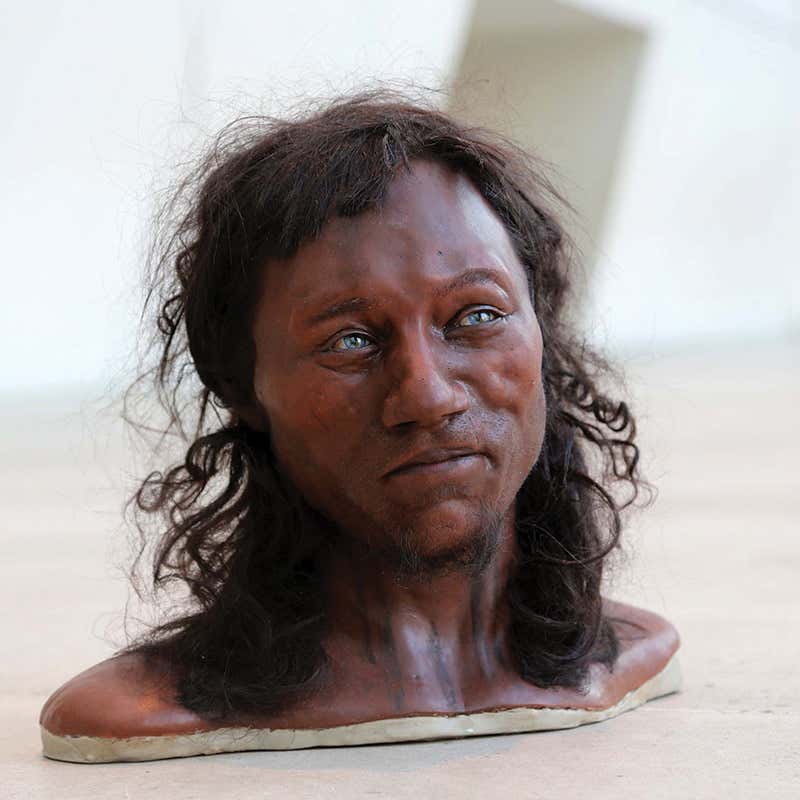
Cheddar Man is a human male fossil found in Gough’s Cave in Cheddar Gorge, Somerset, England. The skeletal remains date to around the mid-to-late 9th millennium BC, corresponding to the Mesolithic period, and it appears that he died a violent death. Analysis of his nuclear DNA indicates that he was a typical member of the Western European hunter-gatherer population at the time, with a most likely inferred phenotype of blue-green eyes, dark brown or black hair, and dark or dark-to-black skin, with no genetic adaption for lactase persistence into adulthood.
Cheddar Man | |
|---|---|
 | |
| Died | c. 8300 BC[1] now Cheddar, England, United Kingdom |
Body discovered | 1903 |
Cheddar Man is a human male skeleton found in Gough's Cave in Cheddar Gorge, Somerset, England.[2] The skeletal remains date to around the mid-to-late 9th millennium BC, corresponding to the Mesolithic period, and it appears that he died a violent death. A large crater-like lesion just above the skull's right orbit suggests that the man may have also been suffering from a bone infection.
Excavated in 1903, Cheddar Man is the oldest near-complete human skeleton found in Great Britain. The remains are kept by London's Natural History Museum, in the Human Evolution gallery.[3][4]
Analysis of his nuclear DNA indicates that he was a typical member of the Western European hunter-gatherer population at the time, with a most likely phenotype of blue-green eyes, dark brown or black hair, and dark or dark-to-black skin, with no genetic adaptation for lactase persistence into adulthood.[5]
Discovery
The individual who became known as Cheddar Man was discovered in December 1903 in Gough's Cave, in Cheddar Gorge, Somerset, in south-west England. The cave had been developed as a tourist attraction by Richard Cox Gough and his family during the late 19th century. Excavation of its downward-sloping entrance led to regular flooding after heavy rain, and Gough began digging a drainage trench to carry the water away. After his death in February 1902, management of the cave passed to his widow, Frances, and their eldest son, Arthur.[6]
The drainage work continued. In December 1903, workmen extending the trench into a recess near the cave entrance uncovered a human skeleton beneath a layer of stalagmite. The recess later became known as Cheddar Man Fissure. The discovery was unexpected, and some information about the original position of the remains was lost during their recovery. The workmen removed the skull before the skeleton could be properly recorded.[6]
Soon afterwards, geologist and physician Henry Nathaniel Davies visited the cave. In April 1904, four months after the discovery, he published the first detailed account of the skeleton and how it had been found. Davies recorded that the skull had lain slightly lower than the pelvis and legs. The legs were drawn up, while one arm was bent with the hand near the back of the head.[6]
Condition
Cheddar Man was found as a nearly complete skeleton. Most of the major bones were present, including the skull and much of the skeleton of the torso, arms and legs, although some bones were missing or damaged. No soft tissue survived; what remained was an unusually complete skeleton.[6]
Grave goods and associated items
No objects can be securely identified as grave goods, or objects deliberately placed with Cheddar Man's body. The only other find considered certainly associated with the skeleton is a lower canine tooth from a wildcat (Felis silvestris). It is not known whether the tooth was deliberately placed with the body.[6]
Numerous worked flints were also recovered from the area of the fissure. Early accounts associated some of these finds with Cheddar Man, but material from different periods occurs in the deposits at Gough's Cave, and the flints cannot be securely linked to the skeleton.[6]
Part of a perforated antler baton was also found during the 1903 excavations in the Cheddar Man Fissure and was reported as having been found near the skeleton. The precise circumstances of its discovery are uncertain, and its association with Cheddar Man was later disputed.[7][8]
Later research places the baton in the much earlier Magdalenian occupation of Gough's Cave, rather than the Mesolithic period in which Cheddar Man lived. A fragment of the same baton, found elsewhere in the cave in 1929–1930, came from deposits rich in Magdalenian remains. The baton therefore cannot be considered a grave good belonging to Cheddar Man.[8]
Scientific analysis

Body and health
The near-complete skeleton was that of an adult male who probably died in his early twenties. Cheddar Man was relatively short compared to modern Europeans, with an estimated stature of around 166 centimetres (5 ft 5 in), and weighing around 66 kilograms (146 lb). Proportionally, he is in most respects similar to modern Europeans, and may be described as 'cold-adapted', but with a high crural index (thigh-length–to–leg-length ratio) which is much higher than the modern European average and higher even than the modern sub-Saharan African average, and a high tibia-length–to–trunk-height ratio similar to modern North Africans.[9]
Dating
Cheddar Man has been directly radiocarbon dated on two separate occasions, giving calibrated dates of 8540–7990 BC and 8470–8230 BC.[1]
Origins
Cheddar Man belonged to the Western hunter-gatherer (WHG) population that dominated most of Western Europe during the Mesolithic. Around 4000 BC, they were replaced by Neolithic farmers who emigrated from the Continent. The Neolithic people had an average of 10% ancestry from Western hunter-gatherers, but almost all of this ancestry came from Continental populations, rather than Britain's original Mesolithic inhabitants.[10][5]
Nuclear DNA was extracted from the petrous part of the temporal bone by a team from the Natural History Museum in 2018.[11][12] Around 85% of his ancestry can be modelled as coming from the Late Upper Paleolithic Villabruna genetic cluster, which forms the great majority of ancestry of Western Hunter Gatherers, with the remaining c. 15% deriving from the Goyet Q2 cave cluster associated with the Late Upper Palaeolithic Magdalenian culture. He is not closely related to the earlier Magdalenian individuals found in the same cave, whose ancestry is entirely from the Goyet cluster.[13]
Phenotype
Analysis of genetic markers, although limited by low sequencing coverage, suggests (based on their associations in modern populations whose phenotypes are known) that he most likely had intermediate (blue-green) eye colour, dark brown or black hair, and dark or dark-to-black skin, with no derived allele for lactase persistence. These features are typical of the Western European population of the time.[5][a][14][11] Unlike Farming populations outside the Tropics, who became lighter-skinned over time because they do not get enough vitamin D from their diet, western hunter-gatherers retained their dark skin because they got enough vitamin D from foods such as oily fish.[15][better source needed] The later immigrations of Early European Farmers and Bell Beaker groups introduced traits of brown eyes, lactose tolerance, and light skin to western Europe.[5][16]
Uniparental haplogroups
Cheddar Man's Y-DNA belongs to I-S2524*,[17] a descendant subclade of haplogroup I2a.[5] I-L38, a primary subclade of I-S2524, has been found in Iron Age males from Denmark.[17] The broader I2a is still extant in males of modern Britain and other parts of Europe.
The mitochondrial DNA of Cheddar Man was assigned to haplogroup U5b1 by a Natural History Museum study in 2018 using next generation sequencing.[5] Some 65% of western European Mesolithic hunter-gatherers had haplogroup U5; today it is widely distributed, at lower frequencies, across western Eurasia and northern Africa. In 1996, Bryan Sykes of the University of Oxford first sequenced the mitochondrial DNA from one of Cheddar Man's molars as U5a using PCR testing. The difference between the older result and the 2018 Natural History Museum result was attributed to the use of older PCR technology and possible contamination.[18][19][20][21]
Death and disposition
It is likely that Cheddar Man was moved to the cave after death as part of what may have been a Mesolithic funerary practice, although it is also possible that he simply died in situ.[5]
Public reception
Soon after the discovery of the skeleton, Cheddar Man became part of a discourse of British nationalism and cultural heritage, with an initially proposed age of 40,000–80,000 years.[22] The specimen was heralded by some as the 'first Englishman'.[22]
The analysis of Cheddar Man's mitochondrial DNA by Bryan Sykes in 1996 was broadcast on a regional television programme in the UK, Once Upon a Time in the West. The programme emphasised the connection between Cheddar Man and Adrian Targett,[23] a history teacher from a local school, both of whom belonged to mitochondrial DNA haplogroup U5, although this cannot demonstrate a direct connection between Cheddar Man and this individual, and many people with the same mtDNA haplogroup could probably be found even within the local area. The programme generated coverage in national and international media, which focused mainly on the supposed relationship between Cheddar Man and the local history teacher, and failed to emphasise that mitochondrial DNA is only passed on through the mother, and makes up only a small proportion of an individual's genome.[24][25]
In 2018, the publication of the genetics study by Brace et al. and subsequent facial reconstruction of a dark-skinned and blue-eyed Cheddar Man resulted in widespread media coverage.[15] This coverage again described Cheddar Man as the "first Brit" (despite older remains of modern humans being known from Great Britain). Public discourse surrounding the reconstruction of Cheddar Man heavily revolved around the themes of immigration, national identity, race, and Brexit. Some saw Cheddar Man's predicted dark skin colour as a helpful counter to anti-immigration arguments, while others claimed it to be fake news or a piece of left-wing propaganda.[26]

Facial reconstruction

In 2018, Dutch artists and reconstruction specialists Adrie and Alfons Kennis set out to reconstruct Cheddar Man's face.[28] They took measurements of his skeleton and worked from a three-dimensional scan of his skull. The scan was used to print a model of the skull, giving them a physical base on which to reconstruct his face.[29]
Genetic analysis provided evidence about his skin pigmentation, eye colour and hair type, which the artists incorporated into the reconstruction.[29] The finished face is displayed beside Cheddar Man's skeleton in the Human Evolution gallery at the Natural History Museum in London.[28]
See also
Notes
- ↑ These predictions were obtained using a multinomial logistic regression model based on a panel of 36 carefully selected SNPs with a low sensitivity of 0.26 for classifying intermediate skin (compared to 0.99 and 0.90 for white and black skin, respectively). The accuracy of the model used could be further improved with "additional (but currently unknown) SNP predictors once identified via future GWAS".[12]
References
- 1 2 Meiklejohn, C (2011). "Radiocarbon Dating Of Mesolithic Human remains in Great Britain". Mesolithic Miscellany. 21: 20–58.
- ↑ Gibbens, Sarah (7 February 2018). "Britain's Dark-Skinned, Blue-Eyed Ancestor Explained". National Geographic. Archived from the original on 9 March 2021. Retrieved 6 May 2025.
- ↑ "Human Evolution", www.nhm.ac.uk, Natural History Museum, retrieved 17 November 2017
- ↑ "Cheddar Man: Mesolithic Britain's blue-eyed boy". www.nhm.ac.uk. Retrieved 1 January 2023.
- 1 2 3 4 5 6 7 Brace, Selina; Diekmann, Yoan; Booth, Thomas J.; Faltyskova, Zuzana; Rohland, Nadin; Mallick, Swapan; Ferry, Matthew; Michel, Megan; Oppenheimer, Jonas; Broomandkhoshbacht, Nasreen; Stewardson, Kristin; Walsh, Susan; Kayser, Manfred; Schulting, Rick; Craig, Oliver E.; Sheridan, Alison; Pearson, Mike Parker; Stringer, Chris; Reich, David; Thomas, Mark G.; Barnes, Ian (2019), "Ancient genomes indicate population replacement in Early Neolithic Britain", Nature Ecology & Evolution, 3 (5): 765–771, Bibcode:2019NatEE...3..765B, doi:10.1038/s41559-019-0871-9, PMC 6520225, PMID 30988490 Supplementary Material (pp. 18-19): "This individual has light or blue/green eye colour, it is not light blue, there are elements of brown/yellow in the eye to give a proposed perceived green colour. Better coverage at the low sequenced marker would clarify this but blue/hazel cannot be ruled out. It is certainly not a brown eyed or clear blue-eyed individual... Skin pigmentation [assumptions about missing information omitted] The following range for skin pigmentation prediction is possible for this individual with these parameters:... Intermediate 0.152 - 0.038 Dark-Black 0.848 - 0.962 Final prediction: Dark/Dark-to-Black skin If we omit the three missing alleles, our tool produces 0.752 and 0.248 probabilities for the intermediate and dark-black category respectively, changing the prediction ranges to 0.752- 0.038 and 0.248-0.962. However, note that this completely removes the locus from the prediction model; hence the prediction will not perform optimally (how the prediction model was made). It is therefore best to have some allele present to infer the most probable range for Cheddar Man and we derive the ranges above from the extreme allele constellations only. Explanation: The missing loci certainly impact on this prediction; however, utilizing the input of all ancestral alleles is the preferred option over the use of the derived alleles at these loci – hence 0.152 for intermediate and 0.848 for Dark-to-Black would be the most probable profile. That being said a broad range is present in both the intermediate and dark-black categories due to the missing loci. Also, this effect of skipping a skin pigmentation prediction category with regards probability values, tends to be observed more often in admixed individuals. What is important to note is the input of the dark-black prediction is significant on the intermediate category and therefore it is acceptable to propose a dark complexion individual over an intermediate/light prediction even though the intermediate range is present. It is unlikely that this individual has the darkest possible pigmentation, but it cannot be ruled out. Better sequencing coverage would clarify to what degree this individual has a dark complexion."
- 1 2 3 4 5 6 Bello, Silvia M.; et al. (2025). "125 years of exploration and research at Gough's Cave (Somerset, UK)". Journal of the Royal Anthropological Institute. doi:10.1111/1467-9655.70004.
- ↑ Parry, R. F. (1928). "Recent Excavations at the Cheddar Caves". Nature. 122: 735–736. doi:10.1038/122735a0.
- 1 2 Bello, Silvia M.; Crété, Lucile; Galway-Witham, Julia; Parfitt, Simon A. (2019). "Investigating the use of Paleolithic perforated batons: new evidence from Gough's Cave (Somerset, UK)". Archaeological and Anthropological Sciences. 11: 5231–5255. doi:10.1007/s12520-019-00847-y.
- ↑ Holliday, Trenton W.; Churchill, Steven E. (2003). "Gough's Cave 1 (Somerset, England): an assessment of body size and shape". Bulletin of the Natural History Museum, Geology Series. 58 (S1). doi:10.1017/S096804620300007X. ISSN 0968-0462.[permanent dead link]
- ↑ Patterson, Nick; Isakov, Michael; Booth, Thomas; Büster, Lindsey; Fischer, Claire-Elise; Olalde, Iñigo; Ringbauer, Harald; Akbari, Ali; Cheronet, Olivia; Bleasdale, Madeleine; Adamski, Nicole; Altena, Eveline; Bernardos, Rebecca; Brace, Selina; Broomandkhoshbacht, Nasreen (27 January 2022). "Large-scale migration into Britain during the Middle to Late Bronze Age". Nature. 601 (7894): 588–594. Bibcode:2022Natur.601..588P. doi:10.1038/s41586-021-04287-4. ISSN 0028-0836. PMC 8889665. PMID 34937049.
- 1 2 "Ancient 'dark skinned' Cheddar man find may not be true". New Scientist. 21 February 2018. Retrieved 22 May 2018.
- 1 2 Walsh, Susan (2017). "Global skin colour prediction from DNA". Human Genetics. 136 (7): 847–863. doi:10.1007/s00439-017-1808-5. PMC 5487854. PMID 28500464.
- ↑ Charlton, Sophy; Brace, Selina; Hajdinjak, Mateja; et al. (24 October 2022). "Dual ancestries and ecologies of the Late Glacial Palaeolithic in Britain". Nature Ecology & Evolution. 6 (11): 1658–1668. Bibcode:2022NatEE...6.1658C. doi:10.1038/s41559-022-01883-z. ISSN 2397-334X. PMC 9630104. PMID 36280785. S2CID 253109710.
 Text was copied from this source, which is available under a Creative Commons Attribution 4.0 International License.
 - ↑ "Cheddar Man FAQ". www.nhm.ac.uk. Retrieved 18 March 2018.
- 1 2 Devlin, Hannah (7 February 2018). "First modern Britons had 'dark to black' skin, Cheddar Man DNA analysis reveals". The Guardian. ISSN 0261-3077. Retrieved 16 March 2023.
- ↑ Haak, Wolfgang; Lazaridis, Iosif; Patterson, Nick; Rohland, Nadin; Mallick, Swapan; Llamas, Bastien; Brandt, Guido; Nordenfelt, Susanne; Harney, Eadaoin; Stewardson, Kristin; Fu, Qiaomei; Mittnik, Alissa; Bánffy, Eszter; Economou, Christos; Francken, Michael; Friederich, Susanne; Pena, Rafael Garrido; Hallgren, Fredrik; Khartanovich, Valery; Khokhlov, Aleksandr; Kunst, Michael; Kuznetsov, Pavel; Meller, Harald; Mochalov, Oleg; Moiseyev, Vayacheslav; Nicklisch, Nicole; Pichler, Sandra L.; Risch, Roberto; Guerra, Manuel A. Rojo; Roth, Christina; Szécsényi-Nagy, Anna; Wahl, Joachim; Meyer, Matthias; Krause, Johannes; Brown, Dorcas; Anthony, David; Cooper, Alan; Alt, Kurt Werner; Reich, David (10 February 2015). "Massive migration from the steppe is a source for Indo-European languages in Europe". Nature. 522 (7555): 207–211. arXiv:1502.02783. Bibcode:2015Natur.522..207H. bioRxiv 10.1101/013433. doi:10.1038/nature14317. PMC 5048219. PMID 25731166.
- 1 2 "I-S2524 YTree". Yfull.com. Retrieved 3 August 2026.
- ↑ "Cheddar Man & the Origins of the British (Tom Booth)". 5 July 2019. Retrieved 3 August 2026 – via YouTube.
- ↑ Bramanti, B; Thomas, MG; Haak, W (October 2009). "Genetic discontinuity between local hunter-gatherers and central Europe's first farmers". Science. 326 (5949): 137–40. Bibcode:2009Sci...326..137B. doi:10.1126/science.1176869. PMID 19729620. S2CID 206521424.
- ↑ Malmström, H; Gilbert, MT; Thomas, MG (November 2009). "Ancient DNA reveals lack of continuity between neolithic hunter-gatherers and contemporary Scandinavians". Current Biology. 19 (20): 1758–62. Bibcode:2009CBio...19.1758M. doi:10.1016/j.cub.2009.09.017. PMID 19781941.
- ↑ Sykes, Bryan, Blood of the Isles (Bantam, 2006) pp. 5–12
- 1 2 Oikkonen, Venla (2018). Population Genetics and Belonging. Cham: Springer International Publishing. pp. 102–103. doi:10.1007/978-3-319-62881-3. ISBN 978-3-319-62880-6.
- ↑ "The family link that reaches back 300 generations to a Cheddar cave". Independent.co.uk. United Kingdom. 8 March 1997.
- ↑ Oikkonen, Venla (2018). Population Genetics and Belonging. Cham: Springer International Publishing. p. 104. doi:10.1007/978-3-319-62881-3. ISBN 978-3-319-62880-6.
- ↑ Pitcher, Ben. “Genetic Prehistory.” Back to the Stone Age: Race and Prehistory in Contemporary Culture, McGill-Queen’s University Press, 2022, pp. 108–142.
- ↑ Brophy, Kenneth (2018). "The Brexit hypothesis and prehistory". Antiquity. 92 (366): 1650–1658. doi:10.15184/aqy.2018.160. ISSN 0003-598X. S2CID 158426247.
- ↑ Lotzof, Kerry. "Cheddar Man: Mesolithic Britain's blue-eyed boy". Natural History Museum. Retrieved 15 September 2026.
- 1 2 Lotzof, Kerry. "Cheddar Man: Mesolithic Britain's blue-eyed boy". Natural History Museum. Retrieved 15 September 2026.
- 1 2 Hendry, Lisa. "Bringing a Neanderthal to life: the making of our model". Natural History Museum. Retrieved 15 September 2026.

External links
- Devlin, Hannah (7 February 2018). "First modern Britons had 'dark to black' skin, Cheddar Man DNA analysis reveals". Guardian. Retrieved 7 February 2018.
- Cheddar Man DNA Secrets ~ with Dr. Selina Brace. Video on YouTube explaining how the Ancient DNA was used..