

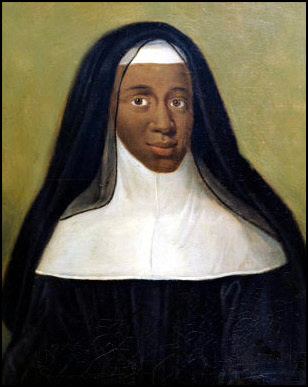
Louise Marie-Thérèse, also known as The Black Nun of Moret (c. 1658 – 1730), was a French nun and the subject of accounts from the 18th century in which she was dubiously claimed to be the daughter of the Queen of France, Maria Theresa of Spain. Her existence is mentioned in several different sources.
Louise Marie-Thérèse | |
|---|---|
.jpg) | |
| Born | 1664 |
| Died | 1732 (aged 67–68) |
Louise Marie Thérèse (1664–1732), known as the Black Nun of Moret, was a Benedictine nun rumoured to be of French royal descent.[1][2]
It alleged that she was the daughter of Queen Marie-Thérèse, however, historians think she was most likely the illegitimate daughter of Marie-Thérèse's husband, King Louis XIV, also known as the Sun King.[2] There were Black servants in the French royal court at the time, so there is a possibility that Louis slept with one of his enslaved servants, and she gave birth to his child.[2]
Her existence is mentioned in the Memoirs of Mademoiselle de Montpensier, Memoirs of Madame de Montespan, and Memoirs of the duc de Saint-Simon.[3][4][5]
History
Birth parentage theories

Rumors created at the court of Versailles suggested that Queen Maria Teresa had a second child, besides Louis, Grand Dauphin, in 1664. This child was rumoured to be Louise Marie Thérèse.[6] There were claims that this child survived infancy and had its existence concealed into adulthood. This birth was alleged to have been the product of a romance with an African courtier who was a dwarf named Nabo.[6] Historians generally support the official account of the child's identity as Marie-Anne, not Louise Marie Thérèse.[6]

Marie-Anne's body was most likely dark-complexioned at birth due to her mother being ill, the infant born premature, and her body being oxygen-deprived, rather than the baby being of African descent. Historians doubt that Marie-Anne survived because attending physicians noted her sickness and nothing else about her appearance, and both her birth and death were subject to public viewing.[6]
Adulthood
Louise Marie Thérèse was a Benedictine nun in the abbey of Notre-Dame of the Nativity Catholic Church in Moret-sur-Loing. She was called the "Mauresse de Moret" ("Mooress of Moret"), and a portrait of her exists in the Bibliothèque Sainte Geneviève in Paris. Research conducted by the Société de l'histoire de Paris et d'Ile-de-France, published in 1924 by Honoré Champion éditions,[7] concluded that this pastel portrait was painted around 1680 by the same hand which painted the series of 22 pastel portraits of Kings of France, from Louis IX to Louis XIV, between 1681 and 1683 on the initiative of Father Claude Du Molinet (1620–1687), librarian of Sainte Geneviève abbey.

The majority of accounts describing Louise Marie Thérèse's life agree that she was financially supported by King Louis XIV. However, many accounts differ on why this was. Voltaire suggested, in 1751, that Louise was likely one of many illegitimate children of King Louis XIV. Others at the time suggested that Louise fabricated the story.[6]
Several writers from the time have devoted paragraphs to her: she is mentioned in the memoirs of Madame de Maintenon, the Grande Mademoiselle, Madame de Montespan, Duke of Saint-Simon, Voltaire, Cardinal Dubois,[8] and in the Journal of the Duc de Luynes. The Duke of Saint-Simon writes:
Legacy and impact
In 1978, French writer Pierre-Marie Dijol published the book Nabo, ou le Masque de Fer, in which he claimed that the nun's father was Nabo, Queen Maria Theresa's dwarf black page, who was removed from court by order of the king soon after Louise Marie-Thérèse's birth, and incarcerated as the Man in the Iron Mask, under the pseudonym of "Eustache Dauger".[11]
Marie-Thérèse's birth is depicted in the first three episodes of the TV drama series Versailles, which premiered in France in 2015. In the show, she is portrayed as the illegitimate daughter of Queen Maria Theresa and Prince Annaba of Assinia, with a dwarf named Nabo implicated and found dead, and the child later used as a political bargaining tool by the prince-turned-king.[12]
References
- ↑ Dee Williams, Shannen (2016). "Forgotten Habits, Lost Vocations: Black Nuns, Contested Memories, and the 19th Century Struggle to Desegregate U.S. Catholic Religious Life". The Journal of African American History. 101 (3). The University of Chicago: 231–260. doi:10.5323/jafriamerhist.101.3.0231. Retrieved March 29, 2025.
- 1 2 3 Blumsom, Amy (June 8, 2016). "Sex, spies and the Queen's black baby: the real history of Versailles". The Telegraph. Retrieved March 29, 2025.
{{cite news}}: CS1 maint: deprecated archival service (link) - ↑ d'Orléans, Anne Marie Louise (1848). Memoirs of Mademoiselle de Montpensier, grand-daughter of Henri Quatre, and niece of Queen Henrietta-Maria. New York Public Library: London, H. Colburn. LCCN 04008152. Retrieved March 29, 2025.
- ↑ de Rochechouart de Mortemart, Françoise-Athénaïs (1899). Memoirs of Madame de Montespan. The Internet Archive: L.C. Page and Company. Retrieved March 29, 2025.
- ↑ de Rouvroy, Louis (1964). Memoirs of the duc de Saint-Simon. New York Public Library: London B.T. Batsford. Retrieved March 29, 2025.
- 1 2 3 4 5 Hall, Lucy B.; L. Weissman, Anna (April 16, 2020). Troubling Motherhood: Maternality in Global Politics. Google Books: Oxford University Press. pp. 97–99. ISBN 9780190939182. Retrieved March 29, 2025.
- ↑ Honoré Champion, ed. (1924). Mémoires de la Société de l'histoire de Paris et de l'Île-de-France (in French). Vol. 47. Société de l'histoire de Paris et de l'Ile-de-France (France).
- ↑ Cardinal Dubois' Mémoires are fictitious, and date from 1814
- ↑ De Rouvroy, Louis (1876). Memoirs of the Duc de Saint-Simon. London (Piccadilly): Chatto and Windus. pp. Vol 2 Ch. XII 1675–1755.
- ↑ La Roche, concierge de la Ménagerie, avait un couple de Maures qui avaient une petite fille et qu'embarrassé, le couple en parla à Madame de Maintenon qui la plaça dans le couvent de Moret, par charité, et en la recommandant vivement.
- ↑ Dijol, Pierre-Marie (1978). Nabo, ou le Masque de Fer (hardcover) (in French). Paris: France Empire.
- ↑ "BBC2 Versailles".