

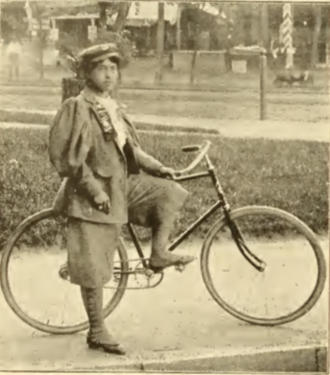
Katherine Towle Knox (October 7, 1874 – October 11, 1900) was a bicycle racer and the first African American to be accepted into the League of American Wheelmen (LAW).
Kittie Knox | |
|---|---|
 Kittie Knox and bicycle | |
| Born | Katherine Towle Knox October 7, 1874 |
| Died | October 11, 1900 (aged 26) |
| Occupation | seamstress |
| Organization | League of American Wheelmen |
| Known for | cyclist |
Katherine Towle Knox (October 7, 1874 – October 11, 1900) was a bicycling barrier breaker and early African American member of the League of American Wheelmen (LAW).[1]
Bicycling career
Knox joined LAW in 1893.[1][2] The organization changed its constitution to only allow white members in 1894. Knox persisted in her membership despite sometimes being denied access particularly while attending a LAW national meet in Asbury Park, NJ. She was a strong rider, participating in century rides.[3] She was a seamstress and took first place in a cycling costume contest at the Waltham, Massachusetts cycle park.[4] During this time, women were expected to wear long skirts when engaging in physical activity. However, Kittie Knox defied gender norms by wearing baggy trousers (bloomers) when cycling and riding a man's bike with a single gear and no brakes.[5] Unlike her male counterparts, much attention was given to her appearance and wardrobe.[1] The media often paid more attention to her looks than to her abilities as a cyclist. [1]
Personal life
Knox was born to Katherine Towle, a white woman from East Parsonfield, Maine, who was a millworker, and John Knox, a black man from Philadelphia who worked as a tailor.[3] Kittie had one older brother, Ernest Knox, who worked as a steamfitter.[1] Kittie was born in Cambridgeport, Massachusetts, and moved to Boston with her family in the 1880s after her father died.[6] At the time, the Boston West End was an impoverished area and had limited opportunities for people of color. Knox found work as a seamstress, which allowed her to express her creativity and design her own cycling costumes.[1]
Knox died from kidney disease in 1900 at the age of 26 and was buried in Mount Auburn Cemetery in a public lot.[7] A headstone was erected for her by family members on September 29, 2013.[8]
Legacy
In 2019, the City of Cambridge, Massachusetts, named the Kittie Knox Bike Path after her. The path connects Broadway and Binney Street in Cambridge.[9][10]
In 2022, MassBike and partners began hosting an annual bike ride in honor of Kittie Knox. [11]
References
- 1 2 3 4 5 6 Miller, Grace (May 26, 2020). "Breaking the Cycle: the Kittie Knox story – Smithsonian Libraries / Unbound". Smithsonian Libraries / Unbound. Retrieved June 13, 2020.
- ↑ "Kittie Knox, Boston's Cycling Craze, 1880–1900: A Story of Race, Sport, and Society book cover". CONTENTdm. Retrieved June 13, 2020.
- 1 2 "African American Heritage Trail – Kittie Knox". Mount Auburn Cemetery. February 1, 2013. Archived from the original on June 7, 2021. Retrieved June 13, 2020.
- ↑ "The Asbury Park Meet". The Bearings. 11 (24): 2. July 11, 1825.
- ↑ "Women in Transportation History – Kittie Knox, African-American Cyclist". Transportation History. March 13, 2017. Retrieved April 16, 2024.
- ↑ Boyd, Herb (November 24, 2022). "Kittie Knox of cycling fame and fashion". New York Amsterdam News. Retrieved April 16, 2024.
- ↑ "Massachusetts, Town Clerk, Vital and Town Records, 1626–2001". FamilySearch. Massachusetts Secretary of the Commonwealth, Boston. p. 2. Retrieved June 13, 2020.
- ↑ "African American Heritage Trail: A Monument for Kittie Knox". Mount Auburn Cemetery. September 30, 2013. Archived from the original on June 22, 2021. Retrieved June 13, 2020.
- ↑ Fallacara, Noelle. "More bike lanes, reduced speed limits on horizon in Cambridge". Cambridge Chronicle & Tab. Archived from the original on June 13, 2020. Retrieved June 13, 2020.
- ↑ "Ames Street Separated Bike Lane Project (Main St to Memorial Dr) – CDD – City of Cambridge, Massachusetts". www.cambridgema.gov. Archived from the original on June 13, 2020. Retrieved June 13, 2020.
- ↑ https://www.bostonglobe.com/2022/06/05/metro/cyclists-honor-black-female-biking-pioneer-late-1800s/